



Both Sides–Joni Mitchell, Then and Now
Roberta Joan “Joni” Anderson was born in Alberta, Canada, on November 7, 1943. She is almost exactly 9 years older than me, and her music was a soundtrack of my high school and college years. Her light, incredibly high soprano voice was always impeccably in tune, though she wasn’t afraid to bend a note when she wanted to. She didn’t need scores of musicians backing her up; on many of her songs, she accompanied herself on guitar or piano–that’s it, so simple, so lush, so perfect. She was a gifted songwriter from an early age, and other major performers recorded her songs before she became a star in her own right.
At age nine, Joni contracted polio and was hospitalized for several weeks. The polio permanently weakened the muscles in her left hand. (A few years later, when she taught herself how to play guitar, she compensated for her fingering challenges by using alternate tunings for the strings. These tunings contributed to untraditional harmonies in her compositions.)
Chelsea Morning, recorded live at Carnegie Hall, NYC, February 1, 1969:
In school, Joni struggled with academics. She was more interested in art. (After high school, she went to art school for one year and didn’t really like the focus on technical skill, abstraction, and commercial art. Though she dropped out, painting has always been a major part of her life. She did the artwork for many or all of her album covers.)
By the time she was eleven, she loved singing and dancing and writing poetry, and thought maybe she could be a performer. In October, 1962, just before she turned 19, she started performing folk music in small clubs and coffeehouses.
Big Yellow Taxi:
In 1964, she discovered she was pregnant. Her boyfriend bailed on her, and after she gave birth to her daughter, she placed her in an adoption, because she didn’t have the financial resources to raise her. She needed to go back to performing. (Joni reunited with her daughter in 1997.)
In 1965, Joni met the American folk singer Chuck Mitchell, and they began performing together. They went on tour in the US, and soon married; Joni Anderson officially became Joni Mitchell. The marriage only lasted a couple of years. In 1982, she married bassist Larry Klein. They divorced in 1994.
Help Me:
The Circle Game:
Joni has always had a lot of support from other musicians. Her friendships are a veritable Who’s Who of the folk, rock, pop, and jazz artists from the 1960s through today. She was linked romantically with the likes of Leonard Cohen, David Crosby, Graham Nash, James Taylor, and Jackson Brown, among others.
Woodstock:
River:
Around 2000, Joni’s voice began to deepen. Although she was a smoker all her life (she started when she was 9), she believes that the loss of the top of her range is due to nodules on her vocal cords, changes in her larynx, and lingering effects of polio.
Coyote, recorded live at Gordon Lightfoot’s house, with Bob Dylan and Roger McGuinn:
Below is an interview from 2013. It is worth your time to watch. One thing she says that really got to me is, “If you listen to that music and you see me, you’re not getting anything out of it. If you listen to that music and you see yourself, it’ll probably make you cry, and you’ll learn something about yourself, and now you’re getting something out of it.” I can’t tell you how many times in my life I’ve listened to Joni Mitchell’s music with tears streaming down my cheeks. The combination of her pure voice, simple accompaniment, and poignant lyrics touches me deeply. These days, when I listen to her, I long for the bright, vivacious young woman she was (and for the bright, vivacious young woman I was).
In 2015, Joni suffered a ruptured brain aneurysm. Her injury caused a great deal of damage, and she worked very hard at her physical therapy to regain her mobility.
When Joni Mitchell was celebrated at the Kennedy Center Honors in 2021, I was heartbroken to see how frail she was, and I wondered if she’d ever perform again.
But you can’t keep Joni down. She appeared at the Newport Folk Festival with Brandy Carlile in 2022.
Both Sides Now, 2022 Newport Folk Festival:
Miss Goody-Two-Shoes No More

For most of my life, whenever I remembered my childhood, especially my elementary school years, I remembered myself as angelically abiding by the rules.
But now that I’m well into the last decades of my life, long-forgotten incidents are emerging from my memory that contradict my early self-image.
I am a child of German immigrants, and I attended parochial school from kindergarten through eighth grade. My parents were careful to speak to my brother and me in English, so that we would grow up with English as our first language. But my mother also taught us a little bit of German, including a prayer.
There were 67 students in my first grade class. Amazing, right? Impossible. But this was during the baby boom. There had been two kindergarten classes, and when we were promoted to first grade, the school had a teacher shortage, and only one teacher for first grade, so they combined us. Our teacher, Sister Gracita, struggled to keep this vast community of six-year-olds under control, and apparently, I was one of her major challenges. She was constantly telling my mother I was “too talkative.” Moi?
I recall one time she took me outside the door of our classroom and told me there were “66 other students in our classroom who are trying to learn” and I was preventing them from doing so. My mind immediately went to arithmetic: 66 students + me = 67, and I lived at 67 Park Avenue! What a coincidence! I wanted to tell Sister, but I sensed she wasn’t interested.
Later that year, we had a visitor to our classroom, another nun. She must have been a supervisor from the diocese, there to observe the teacher, because Sister Gracita had been prepping us on our lessons and our behavior. Toward the end of the visit, Sister said, “And Andrea knows a prayer in German! Andrea, can you please say your German prayer?”
What? All year Sister had been on my case for talking too much, and now she wanted me to perform like a one-trick pony? “No.”
Sister asked again, and I refused again. She asked why, and I said, “I don’t want to.” Sister changed the subject, but later she called my mother and told her I embarrassed her in front of the bigwig. Of course, my mother was mortified, but I didn’t see her point.
Now, 53 years later, I get it, but I’m amazed that I stood my ground when I was six. I really thought I had a healthy respect for authority figures when I was little. Now I’m realizing I was a little rebel.
Posted in Memoir, Personal experience
2 Comments

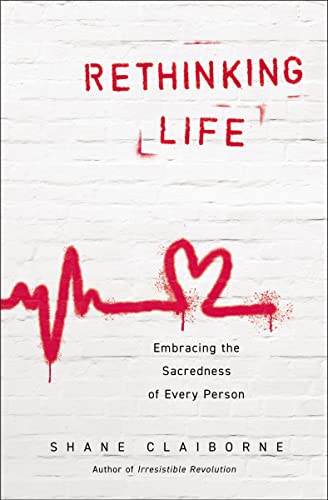
Review of Rethinking Life: Embracing the Sacredness of Every Person by Shane Claiborne
What does it mean to be truly pro-life?
Being anti-abortion does not go far enough.
Claiborne, a Christian activist, provides an in-depth examination of all the elements of a “consistent ethic of life.” Throughout the book, he asks the question, “What does love require of us?”
Every person is sacred, Claiborne says, because God created humanity in His image. “So God created man in his own image, in the image of God he created him; male and female he created them (Genesis 1:27 NIV).” That means everyone. Brown and black and yellow and white. Mother Teresa and Adolf Hitler. Donald Trump and Joe Biden. Brain surgeons and sanitation workers and female impersonators. All are stamped with God’s likeness. Even people we don’t particularly like.
Claiborne includes chapters on the early Christian movement and how it changed when Constantine granted it legitimacy; how Christians have contributed to violence worldwide throughout history; anti-Semitism and genocide; eugenics, racism, slavery, and the death penalty; American exceptionalism; and a chapter on abortion that is one of the clearest analyses I’ve ever read.
For Claiborne, the ultimate authority on life and love is Jesus Christ. He quotes a pastor friend: “We believe in the authoritative, inerrant, infallible Word of God. His name is Jesus.” Claiborne says, “Ultimately, the word Christian means ‘Christlike.’ If something doesn’t smell like Jesus, sound like Jesus, and love like Jesus, it is not Christianity.” A lot of what I hear from people who profess to be Christians does not pass this test.
Pro-life goes beyond opposing abortion. Claiborne quotes a sermon given by the Reverend Doctor Otis Moss III: “I’m pro-life. I’m pro-education. I’m pro-healthcare. Pro-accountability. . . Pro-love. Pro-faith. Pro-equality. Pro-grace. Pro-redemption. Pro-peace. Pro-family, whatever combination that family may be.”

Being pro-life means making sure all people have access to what is necessary for life. Pro-life means insisting on a living wage, free public education, affordable housing, affordable childcare, affordable medical care and prescriptions, food, water and clothing for all. And the list goes on. There is much work to be done. What does love require of us?
Claiborne asks other questions too, and calls us to action. We all can help to bring justice and life to the world:
Jesus taught us to seek first the kingdom of God, and that means asking ourselves some prophetic questions. What would it look like for God’s dream to come on earth as it is in heaven? What would it look like for God’s dream to come to my block, my neighborhood, my city? . . . God’s dream is for us to welcome immigrants as if they are our own flesh and blood (Lev. 19:34). God’s dream is for mercy to triumph over judgment. God’s dream is for us to transform our swords into plows and our guns into garden tools. God’s dream is not for more than one hundred lives to be lost to guns every day in America. . . How can we participate in announcing and ushering in God’s dream? . . . Let us pray that our hearts would be broken by the things that break the heart of God.
Rethinking Life is one of the best books I’ve read this year. I can’t stop thinking about it.

 Allison Boley
 Carol Boley
 dgood648
 Joy
Joy Andrea R Huelsenbeck
 Betty Mason Arthurs
 Linda Carlblom
 Peggy Levesque
 tuesdayschildren100
 Judy Robertson
 Doing Life Together