My thoughts rarely take the form of words. I like to think this is because life’s deepest truths take place outside the realm of words, but maybe it’s just because I’m introverted and not very verbal. But for the first time, I’m helping plan a church event in part for families, and like snowflakes, all my thoughts about singleness and the church are crystallizing. So I’m articulating some of them here while I can, in the hopes that they might give a voice to someone else who’s like me, and that they might provide a different perspective for those who haven’t yet considered it.
I read a blog on this very subject a couple months ago that said something along the lines of that it might be harder to be single in the church than to be single outside the church. I’d take away the “might” and say the church is the only place I’ve found it hard to be single.
I’m single by choice. I love the autonomy, the freedom to serve Christ in any capacity at a moment’s notice. (I also love the autonomy for more selfish reasons.) I love the time to  think in quiet, to pray without interruption, to lie on the floor and listen to music for hours, to just be. I view my singleness as a treasure, and my whole life I’ve only met one guy wonderful enough to make me want to hand over my treasure of singleness. Sure, there are times of loneliness, and in those times I love my singleness a little less. But I view any circumstance that drives me to God as a good thing. And let’s be real: plenty of married people are still lonely. I’d rather be lonely and single than lonely and married. Plus I’m fortunate — like do a dance and a cartwheel fortunate — to have a handful of emotionally intimate friendships and a wide community. I’m also fortunate to live in a time when women don’t have to get married in order to have income or social standing. I like my life.
But I’ve become aware that not everyone is as pleased with the life I’ve chosen. I’ve been called a homophobic slur to my face, insulted in subtler ways, argued with, and nagged as if I were procrastinating a chore. And every time without exception, it’s been by a fellow Christian.
I know I am also fortunate that for the most part, these have been isolated incidents, nothing like what I know many other single Christians experience regularly. Most of all, I’m fortunate that every church I’ve attended is led by people who value singleness and intentionally search for ways to be inclusive. (Realistically, I would not attend a church that didn’t believe singleness is equal to marriage.)
And so I don’t want to dwell on the negative. I want to articulate steps I will take in planning church-wide events in order to intentionally act out the respect I know my church has for singles.
1. I will call it a community event, not a family event. I’ve heard many sermons from many churches about marriage with the disclaimer that it’s great to be single, but today’s sermon is on marriage. But I’ve never in my life heard a disclaimer about how sure, it’s great to be married, but today’s sermon is on singleness (and preferably that sermon would be given by someone who hasn’t spent most of her or his adult life married). While I appreciate the acknowledgement, I’m tired of being the exception, and I don’t want to make anyone else feel like the exception, either. Instead, I will advocate calling the event a community event. That way, families are a subset of community in the same way a group of friends or a Bible study is a subset of community. Don’t get me wrong — it’s fine to have a family-only event, just like it’s fine to have a women-only event or a high school-only event. But if it’s a church-wide event, I’ll do my best not to call it a family event.
2. I will suggest activities that can be enjoyed with or without children. I think it’s vital to make church-wide events accessible to kids, but I also think it’s vital to make church events accessible to adults who don’t have kids. If the only activities at a church carnival, for example, are aimed at kids, then it excludes, even unintentionally, adults who may not feel like giving up an afternoon just to watch everyone else’s kids have fun.
3. I will provide a way for singles to experience the event in groups if they so choose, without it becoming a “singles” group. Many families in my church are fantastic about this actually, about including a single friend as part of their community in a genuine and natural way. But if I’m on the official end of planning, I’d like to make it an official, though ideally natural, part of the event. This particular event we’re planning involves different “stations” to be experienced by groups of people who move from station to station. I think part of respecting singles in this situation harkens back to my first point, by not making it a “family” event, which would encourage people to think about families experiencing the event as a unit by themselves. One alternate option is to group people by arrival time. This could keep families together while including others as part of the group without them feeling awkward like they were being tacked onto a family.
That said, while I’ve thought a lot about being single, particularly in the church, I’m relatively new to this whole church-wide planning thing. I’d love to hear from you in the comments if you’ve traversed this road before me. What other ideas have worked for you to intentionally include those who may not have family in your church?




 I learned the hard way, however, that my old Ricoh camera required film and what is seen through its lens will appear in the picture—and that I should read the operator’s manual. I have cut off the heads of subjects, taken detailed pictures of my feet, and missed my grandbaby completely while capturing upon print an open toilet and dirty towels on the bathroom floor. I once took 36 shots of the Disneyland Electrical Parade—with no film in the camera. In spite of such failures, I won’t part with my Ricoh.
 We didn’t know our family was in the middle of a miracle in October 2015, when my husband John hired a landscaper and his workers to trim our large mesquite tree. Walking by the pop-up camper, he heard a buzzing, stopped and watched a few bees going in and out of a vent hole in the camper. He sprayed the hole with some pesticide. Everyone ran as the bees blasted out and flew into the mesquite tree, preparing to attack. Soon hundreds of swarming, angry bees lined the branches.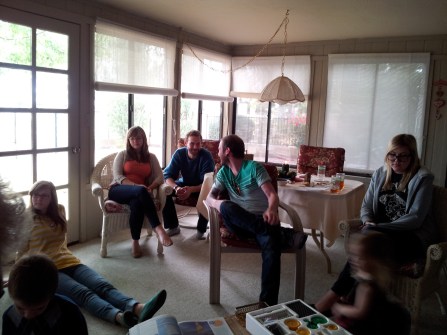


 Some might ask, “What’s the point of a party like this?” (I’m guessing this would be an extrovert.) Here’s the thing. I once was in a family counseling session and told the counselor that I sometimes go in another room just to read in a quieter space. Another family member sometimes joined me with a book of her own. The counselor asked me a question that I’d never considered. “Do you feel a connection to that person when you’re both in the same room reading?” I had to think for a moment. Yes. Yes I did! You really can connect on a fairly deep level without speaking or getting in someone’s space. It was a revelation to me. The point of an introvert party is to connect with others in introverted ways, which are every bit as relevant as the ways extroverts relate.



 Allison Boley
 Carol Boley
 dgood648
 Joy
Joy Andrea R Huelsenbeck
 Betty Mason Arthurs
 Linda Carlblom
 Peggy Levesque
 tuesdayschildren100
 Judy Robertson
