
When I taught elementary general music, the media specialist at my school would invite authors to come to speak to the students. One of the most memorable was Jack Gantos, who came dressed like a nerd with black glasses, a white shirt, and a skinny black tie. He encouraged the students to keep a journal and write down the things that happen to them, and he regaled the kids with stories from his own childhood that had the audience roaring with laughter, similar to this story:
I thought it might be fun to read some of his books. I watched this video:
And it made me want to read Rotten Ralph.
I didn’t like it. I would have been the editor who said, “It’s not for me.” So then I thought I’d try Joey Pigza Swallowed the Key. But I also noticed that he’d written a memoir about his youthful conviction for drug smuggling — what?!! (Maybe you noticed in the above video he said something about the “prison thing.”) I decided to read that first.
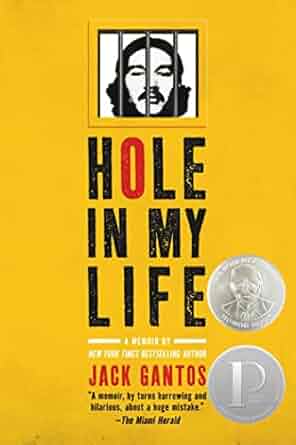
Hole in my Life was written for a young adult audience, but I would not have been comfortable with my children reading it when they were teenagers.
I’m only going to give you a brief summary. I’ve already given the spoiler above, but I can tell you that the story is much more detailed and interesting than what follows.
When Jack was a junior in high school, his family moved from Florida to Puerto Rico. Jack couldn’t speak Spanish, so he couldn’t attend public school there, and his parents could not afford to send him to a private school where English was spoken, so it was decided Jack would go to work. His dad had a construction job, and was able to get Jack a job assisting the electrical subcontractor. Jack had his own on-site hotel room and lived independently, but after a while the novelty wore off (and he had no talent for electricity), so he began to miss school. He’d saved his money and had enough to pay for private school, but his grades had not been good, and he was not admitted to the school.
His parents made arrangements for Jack to return to his previous high school in Florida. They found lodging for him with a local family. He went out drinking frequently, and one night when he came home super drunk and barfed all over the living room, he got evicted.
Jack found new living quarters at a hotel. He thought he’d like to be a writer. He didn’t qualify to take the creative writing class at his school, so he tried writing on his own, without any particular success. And he read. At the end of his senior year in high school, he took a tour of the University of Florida, the one and only college he’d applied to, and seeing it in person convinced him this was not the school for him. So he called his dad and told him he was coming home after graduation to work with him again. His family was now living on St. Croix. (They moved a lot.)
Unfortunately, there was a lot of racial tension on St. Croix. It boiled over, and rich white people’s homes were being broken into. People were murdered. Stores were looted. Tourists were changing their plans. Construction workers lost their jobs, because no one was buying new homes. The only work Jack and his dad could get was building wooden packing crates for people who were leaving the island.
One day a man came to them with plans for a crate with a false bottom. They took the job because they needed the money, but his dad was sure the man was a drug smuggler.
This man, Rik, eventually offers Jack $10,000 to help sail a load of drugs from St. Croix to New York City. Jack sees the money as tuition, his ticket back to college. Easy, peasy. He can’t pass up the opportunity.
But the drug enforcement guys already know all about this operation, and during a delivery, they swoop in and arrest Jack. They already have Rik and another coconspirator in custody, and of course, they’ve cast Jack as the kingpin.
When Jack goes to court, he’s expecting a slap on the wrist and a directive not to deal in drugs ever again. Instead, he gets six years.
Jack is one of those people for whom prison is a wake-up call. He turned his life around.
The reasons I wouldn’t have wanted my kids to read this book as teenagers is that Jack used alcohol and drugs heavily in the years leading up to his arrest, and also, he describes two violent events that happened in prison that he didn’t witness, but saw the after-effects of. However, this book might be just the thing to scare some kids straight. And there’s another reason why Jack Gantos thinks this book is important.
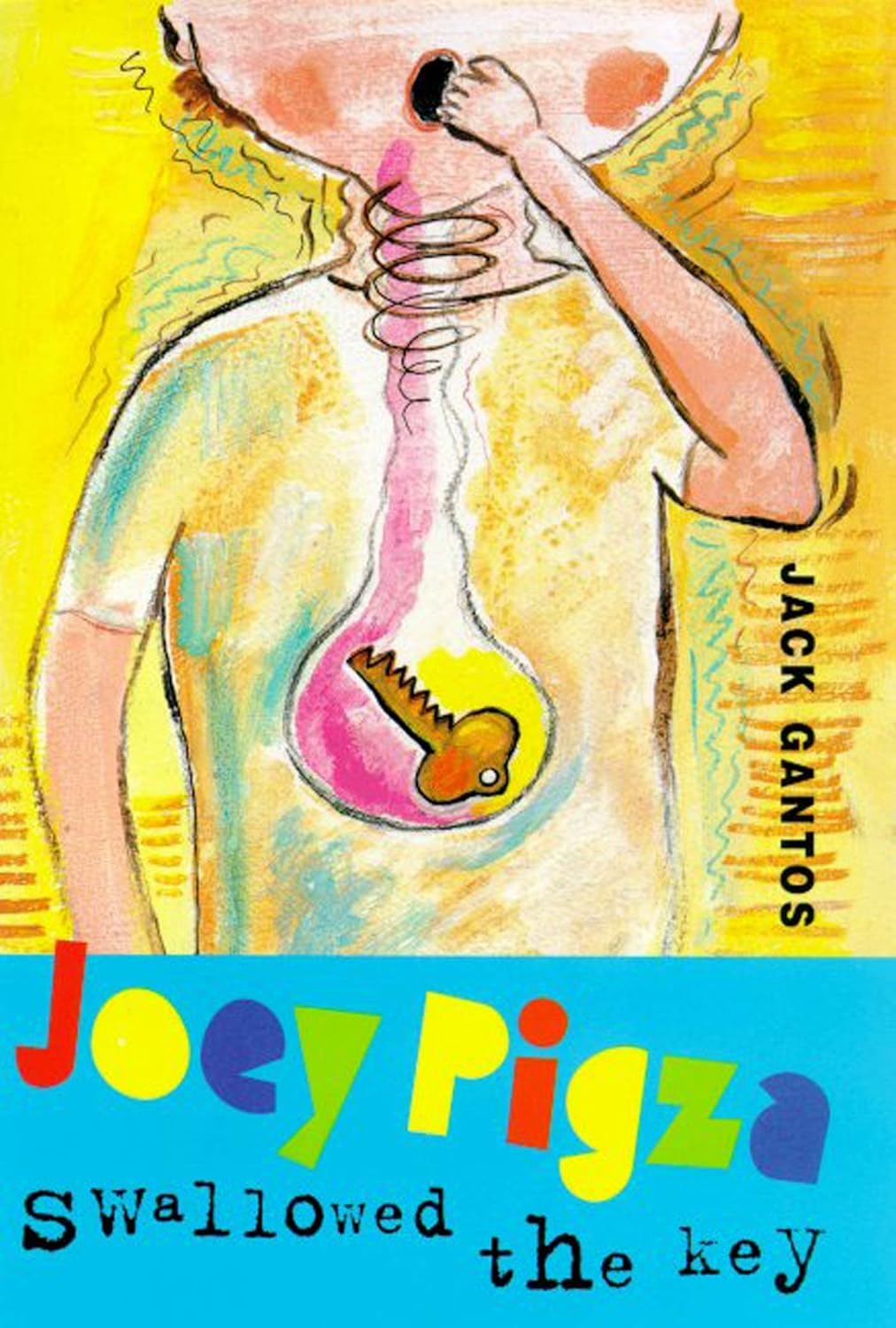
Joey Pigza Swallowed the Key is a middle grades book about a boy with ADHD. When I taught, I had students who had trouble sitting still and staying on-task, but I never had a student who was so severely out of control as Joey Pigza. Gantos does a great job of getting into Joey’s head and showing how jumbled it is. Joey has no impulse control. When an idea comes into his brain, he has to act on it. He’s not a bad kid; he’s actually quite tender-hearted. He gets pulled out of his classroom and transferred to a special ed class and then to a special ed school, where his teachers and specialists and doctor work to help him.
In the beginning, I didn’t like this book. Joey is surrounded by chaos, much of it caused by himself. But due to Gantos’ skillful writing, halfway through the book I was brokenhearted for Joey and rooting for him to get better. Gantos researched ADHD to be able to portray vividly and truthfully what it feels like to be a person with this disorder.
I don’t think all kids would like this book. But I do think kids with ADHD might be encouraged by it, by reading (or having someone read to them) something that rings true and examines the disorder with sensitivity and compassion.

 Allison Boley
 Carol Boley
 dgood648
 Joy
Joy Andrea R Huelsenbeck
 Betty Mason Arthurs
 Linda Carlblom
 Peggy Levesque
 tuesdayschildren100
 Judy Robertson

Like you, I wouldn’t read all these books, but I’m glad you wrote this post.
LikeLike