
Mr. Magoo’s Christmas Carol

When I was a little girl, I watched a cartoon show called Mr. Magoo, about a little old curmudgeon who was near-sighted and hard of hearing, which caused him to get into all sorts of trouble, of which he was blissfully unaware.
In 1962, they produced a Christmas special featuring Mr. Magoo as Ebenezer Scrooge in a musical version of Dicken’s A Christmas Carol. It was televised annually for several decades, long enough for me to memorize the songs (but don’t ask me to sing them today).
A few years ago, I realized that although other Christmas specials I’d enjoyed as a child were still being shown every December, I hadn’t seen Mr. Magoo’s in ages. Just for fun, I googled it last month and found it on Vimeo. I’m posting the link so you and your children can enjoy it as well.
Posted in Christmas
Tagged Christmas and kids, Christmas special, Mr. Magoo's Christmas Carol, Television
Leave a comment
Tangles for Christmas by ARHuelsenbeck
This article first appeared on ARHtistic License last December.
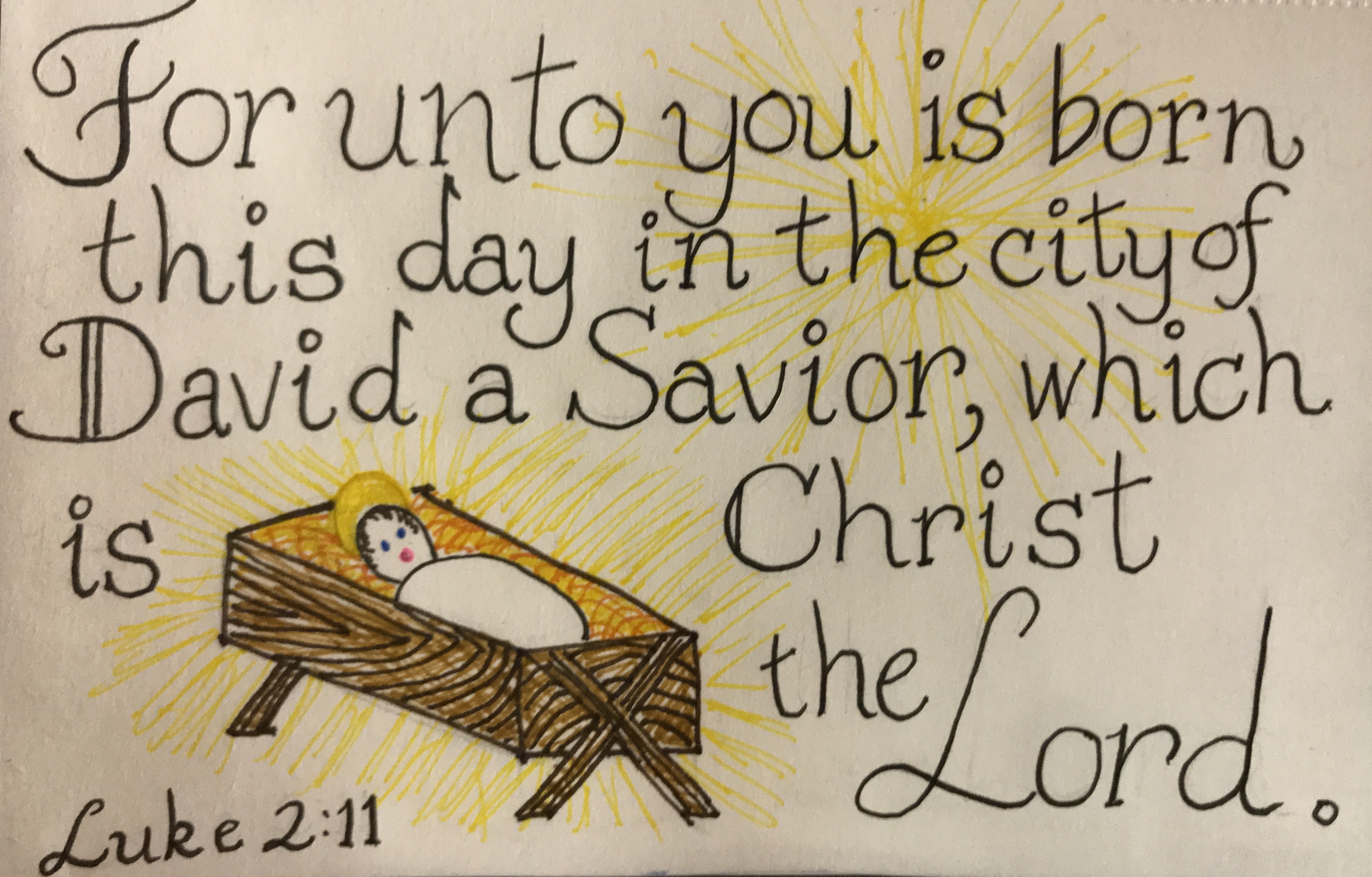
For the last month, I’ve been zentangling Christmas themes. The Facebook Zentangle group I’m a member of, Tangle All Around, spent two weeks designing wreaths. Here’s one I made using the pattern Twistee:

This one uses Riki Tiki and Onomato:

For this one, I made multiple auras around each letter of Merry Christmas:

I think Verdigogh is just screaming that it wants to be a Christmas wreath. Here are two attempts:
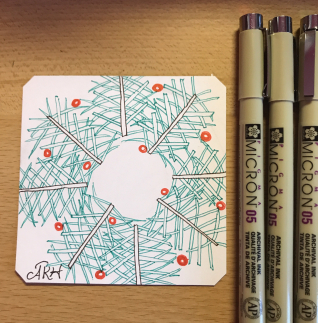
Below is my favorite wreath, made from Flux:

I don’t remember the name of this pattern, but I kind of adapted it to make it lacy:

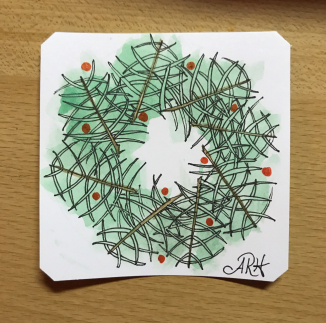
This wreath was made from Golven:

I thought it looked a little plain, though, so I added some color, which made it look more festive:

What do you think? I kind of like the original better.
After the wreath challenge ended, I tried a tree made from Twistee and Snow Flower:

And I decorated some origami stars:

I don’t know all the names of the patterns used below (or if they even have names), but one is a variation of printemps and one is static:

And some of the patterns used below are Muzic, Keeko, Heartline, Printemps, and Shattuck.

Now it’s your turn. Have you done any Christmas art this year, or made any presents? If you’ve posted any online, please leave a link in the comments below so we can see.
I wish you a blessed Christmas and a happy new year.
The RIGHT Way to Serve Cranberry Sauce
A few years ago, I read an article that upset me greatly. In fact, I saved this link so that I could respond to the article when the time was right.
I know cranberry sauce is considered a Thanksgiving food, to go with turkey; but in my family, the Thanksgiving menu and the Christmas menu are indistinguishable. So, if you got it wrong at Thanksgiving, after reading this article you’ll be able to get it right for Christmas.
If you have not read the above-mentioned article, in it Tamela Hancock Murray purports to know the correct way to serve cranberry sauce (the jellied kind that comes in a can). Everyone knows, she says, that “you must slice the cranberry sauce so it appears in rounds and then you serve it in an oblong dish.”
Wrong.
This is how you serve cranberry sauce:
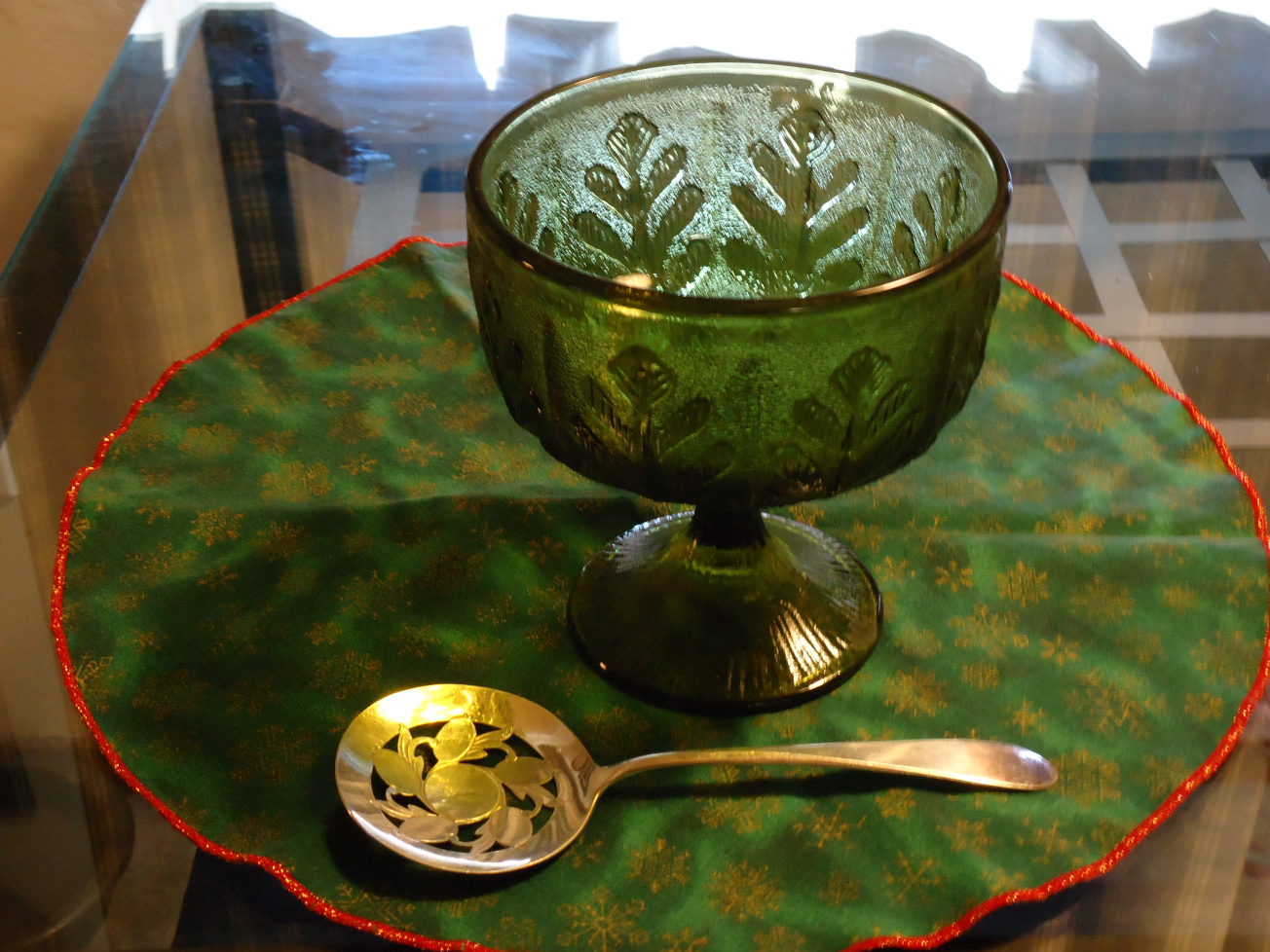
In a green footed bowl used for no other purpose than serving cranberries. (Full disclosure: even though many years ago the bowl came to me filled with a floral arrangement, I knew at that moment that it was born to be a cranberry dish.) After opening the chilled can, shake the cranberry sauce into the dish without marring its cylindrical form. Allow guests to serve themselves with a sterling silver cranberry sauce slicer. (I know for sure this slicer was made specifically for cranberry sauce. It has a circle of cranberries etched into the surface. It was my mother-in-law’s. I gave it to her, and it reverted back to me when she passed away.)
Some of you are undoubtedly dying to tell me that jellied cranberry sauce from a can is far inferior to the other kind. Don’t tell me—tell my husband. It’s what his mother always served. Old traditions die hard.
I have tasted the whole-berry kind, and I love it. I have even made it from scratch, and it was heavenly. I even tried serving it in alternating years.
The only problem with that arrangement is, no one else in my family will eat it. So canned jellied cranberry sauce it is. It’s the only way.
In Praise of Geography

Back in the olden days (late 1950s—early 1960s), geography was taught in elementary schools. Not all elementary schools, apparently, since my husband can’t recall ever studying it, but it was a subject at the parochial school I attended.
I think the first year it was offered was third grade. I remember being disappointed with our textbook, because it didn’t really deal with other countries, which, as a child of immigrants, I hungered to learn about. Instead, it dealt in general terms about land masses and oceans and mountains and map representations. It bored me, but I suppose it laid the groundwork for what was to come.
I can’t remember exactly what came next, but I suppose we learned the names of each continent and ocean and where they were located on a map and on the globe. We learned that we lived in North America, between the Atlantic and Pacific oceans, and that our neighbor to the north was Canada, and to the south, Mexico. My next-door neighbor, Mrs. Brennan, grew up in Mexico, and she gave me a Mexican doll, which I brought to school for geography show-and-tell.

In subsequent years, our study centered on the various countries located on specific continents. We were tasked with learning capital cities and prominent cities, principal exports, languages spoken, forms of government, characteristics of the landscapes and peoples, special customs, and being able to locate the countries on a map and tell what their borders touched.
As an adult, when I taught elementary general music, I would bring in a little geography, showing on the map a composer’s country of origin, or where an ethnic song or dance came from. I would show our location in Chandler, Arizona, and how you had to travel across the United States and sometimes across oceans and other continents to get there.
I’d like to say I remember everything I learned in geography as a child. But so much has changed. Countries have changed names, borders have been redrawn, and sometimes I don’t recall what was what. However, I do have a general idea where to look for places on a map.
I think the study of geography is important, and should be required at least one year at the elementary, secondary, and college levels. It’s such a shame when adults don’t know the difference between Austria and Australia or between longitude and latitude.
Link: Let All Earth Give Thanks
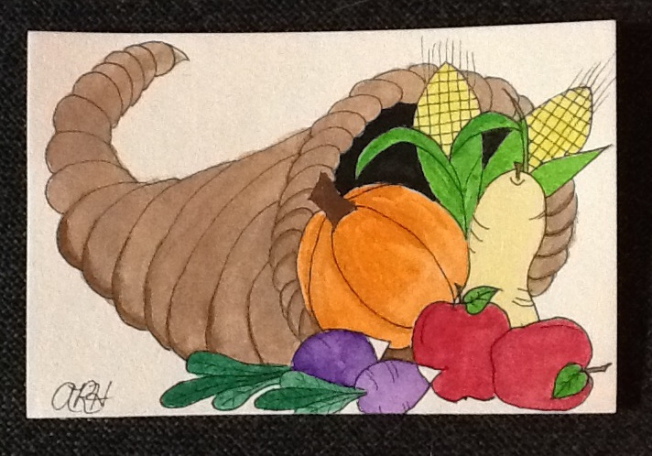
Are you thankful for nature? Click the link and scroll down to hear the author read her poem.
Posted in Poetry, Thanksgiving
Leave a comment
The Creative Soul
This article first appeared on ARHtistic License.

I’ve been introspective lately, thinking about big topics, such as the presence of God in our lives. I want to be a person who is led by God, and I’m having trouble hearing Him.
God is the Creator, and He made us in His image. That means that to a certain lesser extent, we are creators also. We’re cooks and builders and artists and inventors. We make stuff.
I believe my ideas come from God, but sometimes I don’t know what to do with them. I’ve come to a dead stop on some of my books because I know they have the potential to be so much more than they are, and I don’t know how to get them there. I need God to show me what His plan for my work is. I want to catch His vision. I want to plug into His creative power, but I don’t know how to access it. Where is it? Can I reach it with my mind? Or is it deeper still? Is it in my heart? My soul? My spirit?
I’ve prayed about it, and waited quietly for an answer, but it’s been months and I haven’t heard anything yet. And so I wonder.
A book I’ve been reading with my Bible study group mentioned that the soul knows when you’re on the wrong path. I feel like I’m on the wrong creative path and I’m searching for the right one, but I’m so lost. I sensed a whisper that I should define soul, so I’m following a rabbit trail trying to get a handle on it.
Is my soul the same thing as my spirit? I googled the difference between soul and spirit, and one of the articles that came up looked at scripture for answers.
1 Thessalonians 5:23 says, “May God himself, the God of peace, sanctify you through and through. May your whole spirit, soul and body be kept blameless at the coming of our Lord Jesus Christ (NIV).” The way the sentence is structured in the original Greek infers that we are made up of three distinct parts: spirit, soul, and body.
Hebrews 4:12 says, “For the word of God is living and active. Sharper than any double-edged sword, it penetrates even to dividing soul and spirit, joints and marrow; it judges the thoughts and attitudes of the heart (NIV).” You can divide the soul from the spirit just as you can separate joints from marrow; they are two distinct things. But they are also intertwined; it takes something sharper than a double-edged sword to separate them. Have you ever tried to sever a chicken leg joint in order to cook or serve dinner? It helps to have a sharp knife, but even that isn’t enough by itself; you really need good technique not to botch it up. Why? Because it isn’t designed to come apart easily. It would not be beneficial to the chicken for her legs to come off with ease. The word of God divides soul and spirit. What does that even mean?
Glory Dy, the author of the article I read, says “The soul is basically our mind, our emotions, and our will. It is who we are as human beings.” When I tried to define soul in my Zoom Bible study on Monday, I said it is our true self, our essence. I’m not sure I have it nailed down.
In contrast, Dy says, spirit is where we experience God. It is how we connect to the divine.
I’m sorry that my post today raises more questions than it answers. I’m not being very helpful today. If you have insights on the soul and/or the spirit, please feel free to share in the comments.
More thoughts on soul vs. spirit.
In Search of Autumn Leaves
This article first appeared on ARHtistic License last December.
When you live just outside of Phoenix, Arizona, you don’t see a lot of fall leaves. So last Friday my daughter Katie and I traveled an hour to the Boyce Thompson Arboretum, one of our favorite spots for hiking and for picture taking, to see if we could find some. The Arboretum officially celebrates its Fall Foliage Finale on Thanksgiving weekend, but we purposely waited a week to avoid the crowds. We took the High Trail into the wilder part of the Arboretum to get a nice workout.
Even before we reached the trail, we were rewarded with orange and yellow hues, but most of the trees were green. I don’t know if most of the trees in the Arboretum just don’t change, or if our night temperatures in the 40s just aren’t cool enough to trigger death.
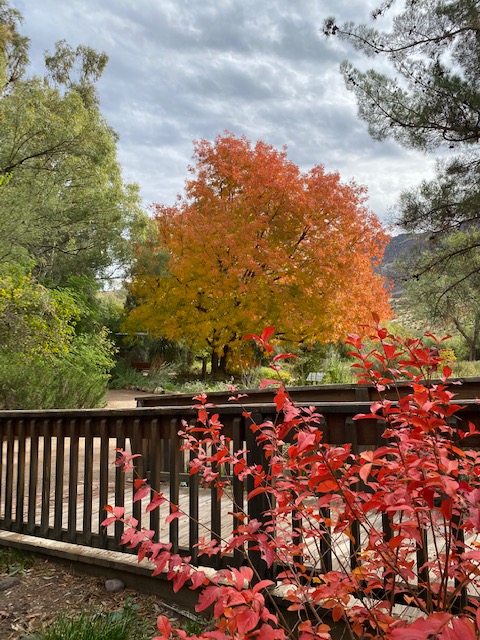


As you can see, our skies were cloudy, which doesn’t often happen here. In fact, we’ve had very few rainy days this year until recently. (As I’m writing this on Monday afternoon, hail is failing outside my window and lightning and thunder are making their presence known.)
Here’s Katie crossing a stream. (Last time we were at the Arboretum, the stream was dry.)

Just beyond the stream was a magnificent example of autumn color.

The views on the high trail were gorgeous.


Crossing the stream on an extension footbridge:


Katie on the bridge.

On the other side of the bridge, the trails are more civilized.

Look at the blazing colors on this tree:

Katie:

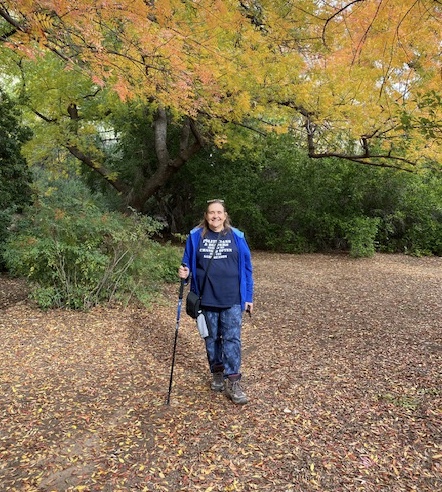
And me, with trekking pole:
A little stone cottage:

A pomegranate:

Look at the gnarly trunk of this tree:

And look at this crazy curlicue branch:

This little boy and his donkey are sculptures:

My daughter took this photo with her phone. Doesn’t she have a great eye?

This was our third trip to the Arboretum together. You can see pictures of our other trips here and here.
Unless stated otherwise, photographs in this article are by ARHuelsenbeck.
St. Anthony’s Monastery, Part III: The Gardens
St. Anthony’s Monastery is located in the desert outside Florence, Arizona. The monastery’s water comes from three wells, each a quarter-mile deep, which turn the grounds into an oasis.


I’ve never seen bougainvillea this color.


Adding to the beauty of the plants are the many outdoor structures and decorative brickwork.


And the fountains.


And the statuary.


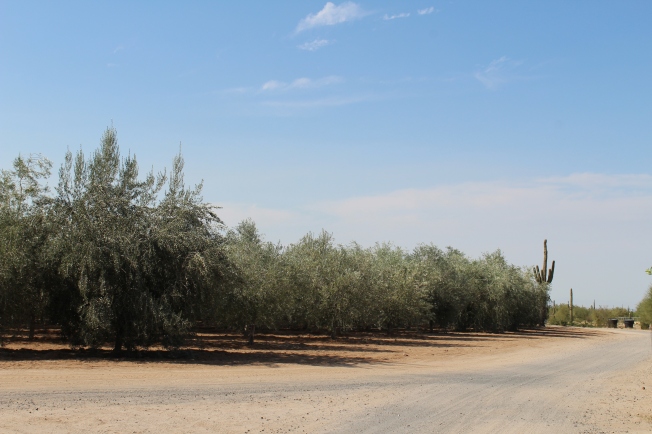
The monks also grow several kinds of citrus, and olives.

If you haven’t seen St. Anthony’s Monastery Part I and Part II, check them out.
 Allison Boley
 Carol Boley
 dgood648
 Joy
Joy Andrea R Huelsenbeck
 Betty Mason Arthurs
 Linda Carlblom
 Peggy Levesque
 tuesdayschildren100
 Judy Robertson
 Doing Life Together