
Happy Thanksgiving to you from all of us at Doing Life Together.
“Softly and Tenderly,” Comfort for All
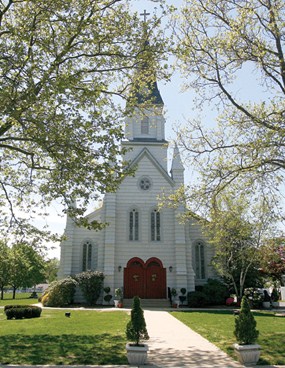
Holy Cross Church
“Softly and Tenderly,” Comfort for All
by
Betty Mason Arthurs
A hymn, written during the horse and buggy days of the 1800s, soared across time and space. It swept into the hearts of the audience of the 2017 Country Music Awards. Performers and fans held their breath as on a large screen flashed 50 photos of those killed in the October massacre at an outdoor concert in Las Vegas. Carrie Underwood sang the hymn, “Softly and Tenderly.” Wiping my tears, along with many others, I once again felt the comfort only God bestows in times of grief, especially through music. We also remember those lost in other attacks, the most recent in a tiny white church in Sutherland Springs, Texas.
Attachments area


Carrie Underwood – Softly and Tenderly – In Memoriam (Live from the 51st Annual CMA Awards)
Will L. Thompson, author of this hymn, traveled by horse and buggy throughout Ohio in the 1800s. Born in November of 1847 in Liverpool, Ohio, Will loved writing and sharing his gospel songs. He attended Boston School of Music and eventually started his own publishing and music store business in East Liverpool and Chicago. Evangelist D.L. Moody and he were close friends and “Softly and Tenderly” was one of Moody’s favorites, often sung as a hymn of invitation in many great evangelistic meetings.
I’d like to share the words to this beautiful hymn:
- Softly and tenderly Jesus is calling, Calling for you and for me;
See, on the portals He’s waiting and watching. Watching for you and for me.
Chorus:
Come home, come home, Ye who are weary, come home,
Earnestly, tenderly, Jesus is calling–Calling O sinner, come home.
- Why should we tarry when Jesus is pleading, Pleading for you and for me?
Why should we linger and heed not His mercies, Mercies for you and for me?
Chorus:
- Time is now fleeting, the moments are passing, Passing from you and from me;
Shadows are gathering, deathbeds are coming, Coming for you and for me.
Chorus:
- O for the wonderful love He has promised, Promised for you and for me;
Tho we have sinned He has mercy and pardon, Pardon for you and for me.
Chorus:
Come home, come home, Ye who are weary, come home.
Earnestly, tenderly, Jesus is calling—Calling, O sinner, come home.
I sang this hymn many times during my childhood years but I had forgotten it until the night of the CMA event. I was raised in tiny white churches in small town America in the 1950s. I can still hear my parents’ voices lifted in song, dad’s tenor and mom’s alto, harmonizing on this gospel hymn. Now I find myself humming the tune or singing the words off and on all day as I pray for the families of those killed across our country and around the world. Its haunting melody and touching words bring me comfort as nothing else has.
My prayer is that you also find the comfort only God can give as we live in dangerous times, not giving into fear and depression. Many dear folk will be missing loved ones from their Thanksgiving and Christmas gatherings. May we echo the words of this hymn as we softly and tenderly pray for them.
Review: The Story of With by Allen Arnold
This review first appeared on ARHtistic License.
In January, I attended a writers’ mini-conference given by Christian Writers of the West. The guest speaker was Allen Arnold, former fiction editor for Thomas Nelson. He spoke at length about inspiration and creativity and how the desire to create comes to us from God as an invitation to closer intimacy with Him.
Arnold’s presentation was so refreshing and invigorating and so full of ideas I wanted to explore further, that I bought two copies of his book, The Story of With: A Better Way to Live, Love, and Create. One was for myself, and the other for my friend Tom, who is struggling to finish writing a very important book. I gave it to him a few days later.
In the meantime, I began reading it.
A large part of The Story of With is an allegory, the story of Mia, a girl whose father disappeared long ago. I found the allegory kind of hokey. Each chapter ended with an explanation of that part of the allegory, which was necessary—I wouldn’t have understood the allegory without the author’s commentary. Which made me wonder—why would Arnold devote so much time and energy to the allegory if it didn’t clarify his premise (and instead required him to interpret it for the reader)? I regretted giving Tom the book before reading it myself.
But before I finished the book, I saw Tom again, and he shared that he had read the book straight through, moved to tears because it affected him so deeply. When I mentioned my disappointment with the allegory, he said for him, it didn’t detract from the message.
These passages from The Story of With especially resonated with me:
-
[God’s] motive in giving you specific talents isn’t primarily so you’ll be productive…It is so your desires can find their fulfillment in Him…God doesn’t need your help as much as He wants your heart (page 120).
-
The door will find you when you are ready (page 205).
-
True success means you create with the Creator, in fellowship with others, as you engage with the community your creation serves. With. With. With (page 213).
-
Living like this ushers in an atmosphere of abundance and freedom. There’s no longer a need to try and control your Story. You know God has even bigger plans than you for what’s ahead. So you are content to ride with Him wherever the path may lead (page 243).
I recommend this book for creative people, but with two caveats. First, if you have no use for God, The Story of With will make no sense to you; it will just be jibberish. (But if you are searching for God, you can find Him here.) Second, if you are looking for the way to make lots of money or fame from your creations, that goal is not addressed here. But if you desire freedom, high quality of creative life, and intimacy with God, you must read this.
Have you already read The Story of With? What is your opinion of it? Share in the comments below. And if you read the book later, come back and let us know what you think.
Posted in Art, Book reviews, Books, Creativity, God, Writing
Tagged Allen Arnold, The Story of With
3 Comments
Not by the Hair of my Chinny Chin Chin…by ARHuelsenbeck
When I was a little girl, our school nurse had a mole on her cheek with a hair growing out of it. I often wondered why she just didn’t pluck it out.
Now it’s nearly sixty years later, and after having cataract surgery, I finally understand.
She never saw it.
I wore glasses for myopia from the time I was ten years old. Gradually, my lenses grew so thick I could hardly find frames hefty enough to hold them. Then my sight became cloudy, and I thought I would have to surrender my driver’s license and give up my job. Fortunately, I passed (failed?) the glare test, which qualified me to have surgery covered by my medical insurance.
With plastic lenses implanted in my eyes, my vision is nearly 20/20 for the first time in my life—for distance. I have to wear glasses to read and to sew, but that’s a happy trade-off for me.

Image by torgakhopper on flickr.
What I didn’t realize, though, is that with or without glasses I can no longer see whiskers on my face and neck, until one day my husband said, “I’m so sorry about your mustache.”
“Huh? What mustache?”
“Your mustache. It must be so embarrassing for you.”
What was truly embarrassing was finding out I had one.
Sometimes when I’m in the car and look at the little mirror on the visor, I’ll see whiskers on my chin and neck. Ew!
But when I get home again and march to the bathroom mirror to yank them out, they’ve vanished. Invisible.
 Sometimes if I turn my head just so—there it is! An inch long, waving in the breeze. But do you think I could grab it with my tweezers? No way. I try and try and try, but my eye-hand coordination on mirror images is not what it used to be. Getting old is for the birds.
Do you remember the scene in My Big Fat Greek Wedding where the mother of the bride has her sister tweezing her stray whiskers? I laughed when I first saw it. Now I wish I had a sister.
Posted in Aging, Doing Life Together, Humor, Marriage
Tagged Facial hair, Mustaches, Tweezers
8 Comments
Remembering 9/11…by ARHuelsenbeck
Two years ago I shared a journal entry I wrote a few days after the 9/11 attacks.
Today, in honor of the sixteenth anniversary of the tragedy, I’d like to share a few more unedited entries from the following days. Please excuse the ramblings and any inacuracies. And let us never forget.
Sunday, 09/16/01:
Bill [my brother] says the WTC was designed to withstand the impact of a 727.
He also said that a lot of cars that parked near his house to catch the ferry Tues. morning are still there. [His condo was located in Highlands, NJ, closer to Manhattan over the water than by land.]
I heard a story about a nurse at St. Vincent’s Hospital. Apparently, you can see the WTC [World Trade Center] from there, and her husband worked in WTC. After the first plane hit, he emailed her (the person on TV said email, but I think it could have been IM) to let her know he was okay. They emailed back and forth–she’d go about her duties and come back and check her email, and answer him back, and go do her next thing. They emailed back and forth for almost an hour, and then the emails [from the husband] stopped. She looked out the window and the tower was gone.
Pastor Todd preached out of Luke 13:1-9 which told about two disasters and whether the victims deserved what happened to them.

Photo by Robert on Flickr
Friday, 09/21/01:
Donna [a co-worker from New York City] said some of her friends’ bodies have been found. Three ladies were found holding hands. They identified them because they had their handbags. Another woman was identified by her handbag and cell phone, but her head was severed.
Saturday, 10/06/01
My main emotion lately is fear–fear of the future, fear of not knowing, fear of uncertainty. I’m afraid because I can’t look at someone and tell whether they are a hijacker/terrorist. The Arizona Republic published pictures of all the hijackers, and except for a couple (who looked crazy), they all looked like people I pass in my neighborhood. Some people talk about “dead” eyes, but I don’t see anything about them that would tip me off that they would be violent. So I’m afraid of everybody.
People are back to “business as usual”–our duty as Americans.
Here I am at Katie’s first AYS softball game at KMS. There are hundreds of people here. Don’t they know we’re in a state of war? Don’t they know 3 1/2 weeks ago 6,000 people died?

I don’t know how to make decisions anymore. Should I tell Erin to go to the most prestigious school she can? Or do I tell her to go to ASU? Should we put down hardwood floors in the halls? New wall-to-wall carpeting? Or is that a silly way to spend money when our house might not even be here six months from now?
President [Bush] wants to propose additional tax breaks to stimulate the economy. How is he going to finance the war if he doesn’t raise taxes?
West Wing [TV drama series] made a point to show how far the Islamic radicals are from Islam. Josh asked the Congressional Classroom (group of high-achieving high school juniors and senior who were selected to participate in a special educational trip to Washington, D.C.) to make a correct association: Islamic radicals are to Islam as _____ is to Christianity. Christian fundamentalists? No. Religious right? No. No one could come up with an additional choice. Neither could I. Josh inserted KKK. The KKK twists the Bible to show that God favors their agenda. Yet nearly all Christians would say they are wrong and disassociate themselves from it.
Yet, I am afraid that even if they are a small faction, they are still widespread. When I see footage of anti-US demonstrations on TV, it looks like hundreds or maybe even thousands of people are involved. If there are two billion Muslims in the world and only 1/2 of 1% are radicals, that would be ten million. That’s a lot of enemies.
Posted in America, Doing Life Together, Memoir, United States of America
Tagged Journaling, September 11
3 Comments
Memories of Our School Lunches by Betty Mason Arthurs
 School has started and I can hear the children’s voices as they walk past our house to elementary school. The good news today in America is that in neighborhoods all across our country, schools are open and ready to educate children.
It seems silly now, but my biggest headache when sending my two kids off to school in the 1970s and 80s was packing their lunches. When I shared my thoughts about school lunches with my writer’s group, each of us had funny memories of peanut butter and jelly, Spam, bologna and ketchup sandwiches. Desserts of Twinkies and Scooter Pies were also stuffed into lunch bags in the 1950s.
Lunches today for our grandkids are hyper-analyzed for nutrition and minus any sweets. Sugary products make students hyperactive and are carefully controlled in most schools. Even the M & Ms in trail mix are a “no no.” Sensitive mothers, coping with school mornings chaos, pluck out the candy, and eat them for a needed energy boost with coffee.
When frustration over children not eating their lunches reached a fever-pitch in the 1980s. my daughter, in elementary school, soon learned what all kids do when confronted with a cafeteria food inspection: you drink your milk and stuff your uneaten food in the carton.
Life was so different when I grew up in the 1950s. Sweets were okay. In junior high my mother spoiled me with Twinkies or Snowballs. Sometimes I even brought a Pepsi from home.
My friend Andrea and her family lived in New Jersey. Her father was a baker and in the years before recycling was normal, she carried her sandwich in a blue and white waxed paper bakery bag. Adding to her embarrassment of being different from her classmates who had brown bags which they threw away, she was to fold the bag and tote it home to be used again. Parents who survived the Great Depression of the 1920s knew how to be frugal. Andrea, became a teacher and raised five children. When she found out they weren’t eating her lunches they were ordered to make their own. “I’ll buy what you want but it’s up to you to make your own lunch or starve.” What a smart mother.
Linda’s mother tucked sweet notes in her lunch. Donna walked home for lunch each day. Judy, raised in Arkansas, loved her peanut butter and mashed banana sandwiches. Peggy had peanut butter and dill pickle sandwiches…really!
For my son and daughter, I made their sandwiches for a week and threw them in the freezer. I still remember spreading out 20 slices of bread on the counter, slapping on peanut butter and jelly or cinnamon sugar for years. Since making lunches drove me crazy, that’s why I begged them to buy their lunch on pizza day in high school. Somehow, in spite of my hatred of lunch packing, they are two of the healthiest people on planet earth.
My daughter became a teacher, raised three boys and became an expert lunch packer. By the time Julie’s boys were in middle school, they carried lunch in a plastic grocery sack which got smashed in your overloaded backpack. Pizza day was cause for celebration. They were so deprived, even if one had a peanut allergy, having to eat a mom-made sandwich, chips, yogurt and home-made cookies. Somehow, they managed to grow up to be big strapping boys.
Julie also shared some stories from her teaching experience. Today parents often go to extreme measures to buy expensive, ergonomically correct lunch boxes which tiny kindergartners lose parts of on the first day of school. The sandwich containers get left behind under lunch tables and are often thrown in the trash. Oh, the agony of motherly aspirations to win the “perfect lunch game” and desire to achieve the standard set by nutrition experts.

There’s a famous lunch story found in the Bible in John, chapter six. Jesus is speaking to a huge crowd and becomes concerned about their need for food. “Where can we buy bread to feed these people?” he asked his disciple Phillip. You can imagine this disciple calculating the cost, “Two hundred silver pieces wouldn’t be enough.”
Andrew told Jesus and Phillip, “There’s a little boy here who has five barley loves and two fish. But that’s a drop in the bucket for a crowd like this.” (The Message Bible) Imagine a caring mother handing her son a lunch and saying, “Jacob, don’t lose this and stay out of trouble.”
Five thousand people sat down on the grass. Jesus took a simple, small lunch and gave thanks. All the people ate their fill with 12 baskets of pieces of the barley loaves left over.
I can see Jacob running home and shouting to his mother, “You’ll never believe what happened with my lunch!” Perhaps they did a happy dance and sang a song of joy. Yes, it was a miraculous lunch that fed a crowd.
Every day dads and moms send their children off to school with a lunch, hugs and prayers, a tradition spanning hundreds of years. What are some of your memories of lunches? Do you make lunches for your children? What do you make for them? Please share your thoughts with us.
Posted in children, food, Life Transitions, Lunch, Parenting, School
Tagged Back to School, memories of school, sack lunches, school lunch
2 Comments
Torrential Rains and Flooding
Torrential Rains and Flooding
by
Betty Mason Arthurs
Today in America our hearts, our eyes and our ears are tuned to the reports coming out of Texas and the devastation caused by Hurricane Harvey. In Houston, over 32,000 people have been rescued from torrential rains and flooding. Last night TV news showed the reunion of a mother rescued by boat with her older daughters. With joyful shouts they called to one another across the water until they were safe in one another’s arms. The mother cried and told the reporter, “God is good. God is so good.” There were many photos but one of a small girl, in a shelter, with her arms around her towel-wrapped puppy brought tears to my eyes.

Once upon a time there was the great flood of 1951 in the Great Plains of Kansas.
A young family lived in the small town of Manhattan. Their lives revolved around family, school and church gatherings. To the five-year-old girl, Elizabeth, life in the summer meant endless days of barefoot fun in her sandbox, climbing trees and hours swinging in her tire swing. Often her friend Joanne walked over for a visit and they played with paper dolls and coloring books.
One day in June it started to rain. It rained for a month which was unheard of in the Great Plains. By July, the rivers crested and soon townspeople frantically tried to prepare for flooding. The girl’s parents and her two older brothers, Mark, age nine, and Don, age 13, carried furniture and boxes of belongings up to the second floor of their small, two bed room house just off the main thoroughfare. The sanctuary of the church next door, where their father was pastor, was on second floor so the pews and the organ would be safe, but they moved Bibles and Sunday school materials up from the basement. On July 12th , her father drove their car to higher ground just in case it did flood.
The girl’s father, Pastor Willard and her mother, Lois, had decided they would stay at the house. They honestly didn’t think there would be any flooding close to their home. Elizabeth remembers clutching her beloved doll and watching from the front porch through the torrential rain as the water rushed down the street and up to their house. A black dog frantically seeking shelter swam up to the porch and her brothers pulled him to safety. The family’s dog, Bing Crosby, fought to protect his territory from this stranger so the animals were tied up on opposite ends of the porch.
With flood waters rising, it was time to evacuate along with their neighbors. A kind man in a yellow rain poncho piloting a boat docked next to the porch and the rain-drenched family, clutching a suitcase with a few belongings, gratefully climbed in. Mark held Bing and Don grabbed the black mutt. Years later Elizabeth still remembered the stinky dogs. Sheltered in her mother’s arms under a tarp, she listened to her mother’s softly spoken prayers for safety. They reached dry ground and the strange dog ran off. For three weeks they stayed with a compassionate church family, the Nelson’s, who lived close to Kansas State University, while the flood waters receded.

To Elizabeth, the flood of 1951 was an exciting adventure and the only bad memory was the immunizations required for all the community. To her parents and brothers, the cleanup was a monstrous task with flood waters filling up the house and church basements and reaching three feet in the house. Neighbors helped neighbors rebuild their community.
You can do a Google search “The Great Flood of 1951 in Manhattan, Kansas” on July 13 and see the town’s devastation. The cities of Topeka and Kansas City, along with Fort Riley, and many other communities also survived horrific damage due to flooding.
http://www.wow.com/wiki/Great_Flood_of_1951?
https://en.wikipedia.org/wiki/Manhattan,_Kansas
Yes, I was five-year-old Elizabeth in this story and I have never forgotten my big adventure and being safely evacuated by boat. My heart goes out to the people of Texas and I pray for their protection and peace as they rebuild their lives.
I find comfort in the words of Scripture in verse 6 of Deuteronomy 31:
“Be strong and courageous. Do not be afraid or terrified because of them, for the Lord your God goes with you; he will never leave you or forsake you.”
Do you have memories of being rescued in the midst of disaster? Have you lost your home? How long did it take you to rebuild? Please share in the comments below.
The Joy of Childhood Poetry…by ARHuelsenbeck
This article first appeared on ARHtistic License.
One of my earliest memories is of my mother reading Mother Goose books to me. I know that even as a little tot I had a large repertoire of rhymes that I could recite by heart. In kindergarten we learned lots of songs that were essential nursery rhymes set to music: Jack and Jill, Baa Baa Black Sheep, Old King Cole, London Bridge is Falling Down, and many others. Mother Goose nursery rhymes were a passage of childhood for my generation, as they had been for hundreds of years.
 When our children were young, we continued the tradition, buying different collections of rhymes and reading them to the kids over and over so that they soon knew them by heart. There’s something about rhyme and meter that imbed themselves in the unconscious, and even more so if they’re combined with a tune. I think you could sing the first line of a Mother Goose rhyme to an Alzheimer’s patient, and he’d be able to finish it for you.
To my sorrow, I found during my second teaching career (2006-2014) that most of my elementary school students weren’t familiar with nursery rhymes. In elementary general music, many activities start with a well-known rhyme. Since my students didn’t have a shared knowledge base of rhymes, I had to teach them a rhyme first before we could use it as the basis of a music experience. Sigh.
Back in the day, memorization of poems was a popular classroom activity. Few teachers today are able to spend time on this pursuit, because it’s usually not measured on standardized tests.
However, I still partially remember four poems I learned from Mrs. Susan Westerfield when I was in second grade, more than fifty years ago. Since they are in the public domain, I will share them with you. (Please forgive the improper formatting. I am a dunce when it comes to code.)
 The Swing
By Robert Louis Stevenson
How do you like to go up in a swing,
Up in the air so blue?
Oh, I do think it the pleasantest thing
Ever a child can do!
Up in the air and over the wall,
Till I can see so wide,
Rivers and trees and cattle and all
Over the countryside—
Till I look down on the garden green,
Down on the roof so brown—
Up in the air I go flying again,
Up in the air and down!
 My Shadow
By Robert Louis Stevenson
I have a little shadow that goes in and out with me,
And what can be the use of him is more than I can see.
He is very, very like me from the heels up to the head;
And I see him jump before me when I jump into my bed.
The funniest thing about him is the way he likes to grow-
Not at all like proper children, which is always very slow;
For he sometimes shoots up taller like an india-rubber ball,
And he sometimes gets so little that there’s none of him at all.
He hasn’t got a notion of how children ought to play,
And can only make a fool of me in every sort of way.
He stays so close beside me, he’s a coward you can see;
I’d think shame to stick to nursie as that shadow sticks to me!
One morning, very early, before the sun was up,
I rose and found the shining dew on every buttercup;
But my lazy little shadow, like an errant sleepy-head,
Had stayed at home behind me and was fast asleep in bed.

The Duel
By Eugene Field
The gingham dog and the calico cat
Side by side on the table sat;
’Twas half-past twelve, and (what do you think!)
Nor one nor t’other had slept a wink!
The old Dutch clock and the Chinese plate
Appeared to know as sure as fate
There was going to be a terrible spat.
(I wasn’t there; I simply state
What was told to me by the Chinese plate!)
The gingham dog went “bow-wow-wow!”
And the calico cat replied “mee-ow!”
The air was littered, an hour or so,
With bits of gingham and calico,
While the old Dutch clock in the chimney-place
Up with its hands before its face,
For it always dreaded a family row!
(Now mind: I’m only telling you
What the old Dutch clock declares is true!)
The Chinese plate looked very blue,
And wailed, “Oh, dear! what shall we do!”
But the gingham dog and the calico cat
Wallowed this way and tumbled that,
Employing every tooth and claw
In the awfullest way you ever saw—
And, oh! how the gingham and calico flew!
(Don’t fancy I exaggerate!
I got my views from the Chinese plate!)
Next morning where the two had sat
They found no trace of the dog or cat;
And some folks think unto this day
That burglars stole the pair away!
But the truth about the cat and the pup
Is this: They ate each other up!
Now what do you really think of that!
(The old Dutch clock it told me so,
And that is how I came to know.)

Wynken, Blynken, and Nod
By Eugene Field
Wynken, Blynken, and Nod one night
Sailed off in a wooden shoe,—
Sailed on a river of crystal light
Into a sea of dew.
“Where are you going, and what do you wish?”
The old moon asked the three.
“We have come to fish for the herring-fish
That live in this beautiful sea;
Nets of silver and gold have we,”
Said Wynken,
Blynken,
And Nod.
The old moon laughed and sang a song,
As they rocked in the wooden shoe;
And the wind that sped them all night long
Ruffled the waves of dew;
The little stars were the herring-fish
That lived in the beautiful sea.
“Now cast your nets wherever you wish,—
Never afeard are we!”
So cried the stars to the fishermen three,
Wynken,
Blynken,
And Nod.
All night long their nets they threw
To the stars in the twinkling foam,—
Then down from the skies came the wooden shoe,
Bringing the fishermen home:
’Twas all so pretty a sail, it seemed
As if it could not be;
And some folk thought ’twas a dream they’d dreamed
Of sailing that beautiful sea;
But I shall name you the fishermen three:
Wynken,
Blynken,
And Nod.
Wynken and Blynken are two little eyes,
And Nod is a little head,
And the wooden shoe that sailed the skies
Is a wee one’s trundle-bed;
So shut your eyes while Mother sings
Of wonderful sights that be,
And you shall see the beautiful things
As you rock on the misty sea
Where the old shoe rocked the fishermen three,—
Wynken,
Blynken,
And Nod.
I even remember drawing illustrations for Wynken, Blynken, and Nod.
What about you–did you learn nursery rhymes as a child? Did you memorize poems in elementary school? What are some of your favorites? Share with us in the comments below.

 Allison Boley
 Carol Boley
 dgood648
 Joy
 Andrea R Huelsenbeck
 Betty Mason Arthurs
 Linda Carlblom
 Peggy Levesque
 tuesdayschildren100
 Judy Robertson

