
I don’t like other people telling me what God is saying to me. I will discern God’s messages by myself, thank you.
So I was very skeptical years ago when good friends of mine presented me with a copy of Young’s daily devotional, Jesus Calling: Enjoying Peace in His Presence. The concept—which I pictured as a daily phone call from Jesus—seemed kind of hokey to me. I read a few entries, and left the book in the kitchen, where I’d occasionally notice it and read a little.
In the meantime, I struggled with the idea of trusting God. I had a difficult career decision to make, and it seemed as though God was ignoring my pleas for guidance. How could I trust Him if He wouldn’t tell me what to do?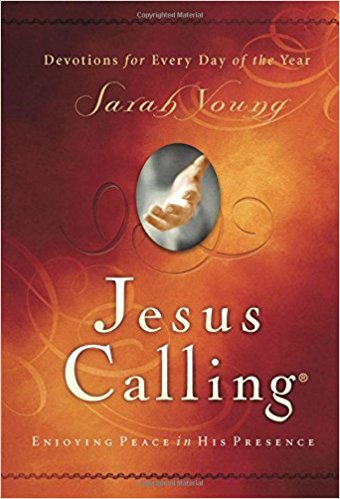
Then, one October 10th, I picked up Jesus Calling and read the devotion for the day. These words commanded my attention; I knew they were written especially for me:
Trust Me enough to let things happen without striving to predict or control them. Relax, and refresh yourself in the Light of My everlasting Love…
… live fully in the present, depending on Me each moment…learn to rely on Me in every situation. This discipline will enable you to enjoy life more and to face each day confidently.
Oh. I can trust God moment by moment. I don’t have to have the whole path laid out beforehand. And soon, God confirmed for me that the default I fell into after resigning from my teaching job—reconnecting with my critique group and refocusing on my writing—was exactly where He wanted me to be. He’d answered my prayer before I’d even prayed it, though it took me a year to notice.
Here’s another reading that helped me greatly (January 26th):
Give up the illusion that you deserve a problem-free life. Part of you is still hungering for the resolution of all difficulties. This is a false hope! As I told My disciples, in the world you will have trouble…
…My Light shines most brightly through believers who trust me in the dark…When things seem all wrong, trust me anyway. I am much less interested in right circumstances than in right responses to whatever comes your way.
I gained a new respect for Young’s work. She’s not pretending she knows what Jesus is telling me. Instead, based on her long immersion in Scripture, she distills the universal message from Jesus to those He loves—the invitation to intimate communion with Him, what she calls the “peace in His Presence.” Each devotion includes two or three Scripture references that apply. (My edition just lists the references; some of the deluxe versions have the passages printed out. If you buy this book, it’s worth it to pay the extra price so you don’t have to look up all the Scriptures—although you might spend more time in God’s Word if you do.)
My original reservation is no longer a concern for me. Jesus Calling helps me in my walk with Christ. I don’t read it every day, but when I do, it gives me a strategy for drawing closer to Jesus.
How about you? Do you long for a closer relationship with Jesus? Have you read Jesus Calling? Share your thoughts in the comments below.









 I have to admit, when I am on my knees praying I don’t stay very long as it hurts my knees. It’s down, a few words, and up as quickly as possible. While on my knees in this humbled position, it seems my prayers are more intense.





 Allison Boley
 Carol Boley
 dgood648
 Joy
Joy Andrea R Huelsenbeck
 Betty Mason Arthurs
 Linda Carlblom
 Peggy Levesque
 tuesdayschildren100
 Judy Robertson
 Doing Life Together